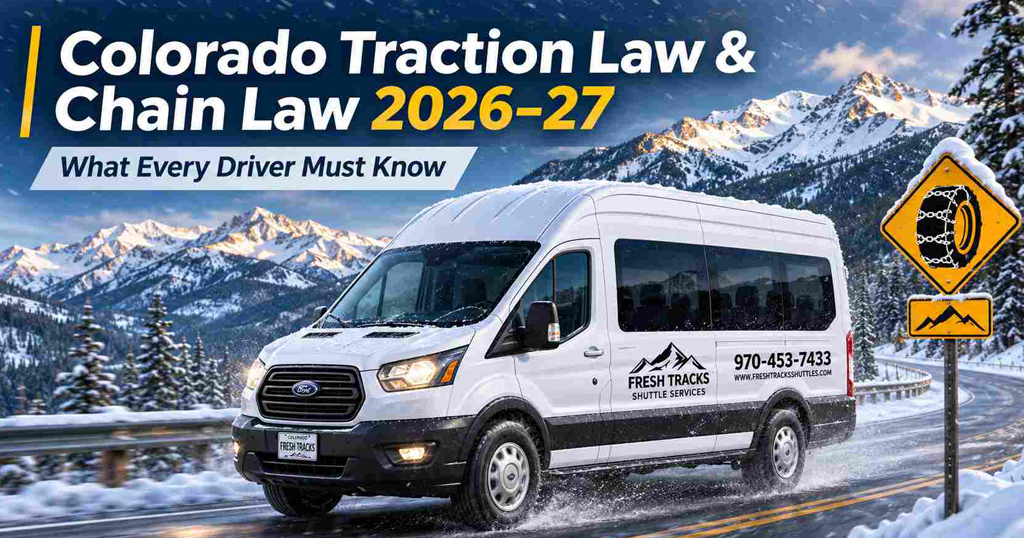
You land at Denver International Airport (DIA) and head for the mountains. Then a sign flashes “Traction Law in Effect.” The Colorado traction law decides whether you keep driving or pay a fine.
From September 1 to May 31, the law stays active on Interstate 70 (I-70) from Dotsero to Morrison. Your tires need 3/16-inch tread plus an M+S, mountain-snowflake, or all-weather rating. Without qualifying tires, you need chains or an approved traction device on two drive tires.
Below, you’ll learn the 2026 changes, the fines, rental car traps, and an easier way up the mountain.
Quick Answer: What Is the Colorado Traction Law?
The Colorado Passenger Vehicle Traction Law (formerly Code 15) is a winter rule for passenger vehicles under 16,001 pounds. When the law is active, your tires need 3/16-inch tread and a qualifying winter rating. If your tires fall short, you must install chains or an approved Alternative Traction Device (ATD). The rule now applies the same way to every drivetrain.
Traction Law vs Chain Law Colorado: Side-by-Side Comparison
Many drivers mix up the two rules. Code 15 is the traction law, and Code 16 is the passenger vehicle chain law.
The Passenger Vehicle Chain Law (formerly Code 16) is far stricter. The Colorado Department of Transportation (CDOT) uses it as the last step before closing a highway.
| Feature | Passenger Vehicle Traction Law (formerly Code 15) | Passenger Vehicle Chain Law (formerly Code 16) |
| When CDOT uses it | Snowy or icy roads; always in effect on I-70 Dotsero–Morrison, Sept. 1–May 31 | Severe storms; final step before a closure |
| Vehicles covered | Passenger vehicles under 16,001 lbs: two-wheel drive (2WD), all-wheel drive (AWD), four-wheel drive (4WD) | Same vehicles, including AWD and 4WD |
| Tire-only option | Yes, if tires qualify | No tire-only option |
| What you need | Qualifying tires or chains/ATD on 2+ drive tires | Chains or approved ATD on drive tires |
| How often | Common during winter storms | Rare; last used March 2019 |
What Is Chain Law in Colorado?
What is chain law in Colorado? Put simply, every car must chain up. Great snow tires alone won’t save you.
- A brand-new 4WD truck still needs chains or an ATD.
- Approved ATDs include textile tire socks like AutoSock and ISSE.
- You can find the full device list on the CDOT Approved Products List.
When the Passenger Vehicle Chain Law is activated, start looking for a safe exit. A full closure often follows.
Where the Colorado Winter Traction Law Applies and When
The Colorado winter traction law has a fixed season and a flexible reach. Knowing both helps you plan your trip.
The I-70 Mountain Corridor: Dotsero to Morrison
From September 1 through May 31, the law stays in effect on I-70 between Dotsero and Morrison.
- The stretch covers Vail Pass and the Eisenhower-Johnson Memorial Tunnels.
- The stretch also passes Idaho Springs, Georgetown, Silverthorne, Frisco, and Copper Mountain.
- Snow can fall as early as September at high elevations.
Mountain Passes and Other State Highways
CDOT can activate the rule on any state highway, not just I-70.
- Heading to Breckenridge? You leave I-70 at Frisco and follow Colorado Highway 9.
- Heading to Keystone? You follow U.S. Highway 6 east of Dillon.
Both routes can carry restrictions during storms. Plan your Denver Airport to Breckenridge route or Denver Airport to Keystone trip with weather in mind.
Check the Colorado Chain Law Map Before You Drive
The state’s live Colorado chain law map sits on COtrip.org. The map shows every active traction and chain restriction.
- Watch the overhead message signs along mountain highways.
- Dial 511 inside Colorado for recorded updates.
- Sign up for CDOT text or email alerts.
- Check our I-70 road conditions page for real-time corridor updates.
Colorado Passenger Vehicle Traction Law: Tire Requirements
Your tires, not your drivetrain, now decide compliance. The 2026 update makes the Colorado passenger vehicle traction law simpler to follow.
What Changed for 2026–27: HB26-1237
The rules shifted twice in two years. Here’s the short version.
- 2025: Senate Bill 25-069 rewrote the law and confused two-wheel-drive owners.
- Late 2025: Lawmakers admitted the wording caused confusion and needed clarification.
- May 5, 2026: House Bill 26-1237 was signed into law. (Effective August 12, 2026. Note: the Colorado State Patrol’s guidance page still shows the old 2WD rule and has not been updated since this law took effect — the statute above is the current law; check CDOT’s traction-law page for the latest wording.)
- Today: One tire standard applies to 2WD, AWD, and 4WD vehicles alike.
Older blog posts still say 2WD cars can’t comply with tires alone. Those posts are outdated.
Tread Depth: The 3/16-Inch Rule
Your tires need at least 3/16 inch of tread. That’s about 4.8 millimeters.
- CDOT promotes a quick quarter test for a fast check.
- A tread depth gauge from any auto store gives you an exact reading.
- Measure several spots on each tire, since wear is often uneven.
Tire Markings That Count
Check your tire sidewall before every mountain trip.
| Sidewall Marking | Meaning | Compliant? (with 3/16″ tread) |
| Mountain-snowflake icon | Winter-rated tire | ✅ Yes |
| M+S or M/S | Mud and snow rated | ✅ Yes |
| Manufacturer “all-weather” rating | All-weather tire | ✅ Yes |
| All-season with no M+S mark | Not listed by CDOT | ❌ Carry chains or an ATD |
Insider tip: Many all-season tires already carry an M+S stamp. Check your sidewall before you buy new tires.
Does AWD or 4WD Still Matter?
AWD helps you accelerate on snow, but it doesn’t help you stop. Bald tires on an AWD SUV fail the rule. A front-wheel-drive sedan on good M+S tires passes. CDOT still recommends AWD or 4WD for mountain driving.
Fines and Penalties Under the Colorado Traction Law
A spinout can cost far more than a ticket. Know the numbers before you climb.
| Violation | CDOT Published Penalty |
| Driving without compliant equipment | $100 fine + $33 surcharge |
| Blocking or closing a travel lane | $500 fine + $157 surcharge |
Note: a November 2025 CDOT/State Patrol release listed lower figures ($50 + $17). The amounts above are from CDOT’s current traction-law page — use those.
What Enforcement Really Looks Like
- Commercial chain enforcement is heavy: between September 1, 2025 and May 31, 2026, 2,405 commercial drivers were cited statewide for chain violations.
- State Patrol troopers wrote 586 of those commercial citations, and 522 of them were on the I-70 corridor.
- Most tickets follow a spinout, crash, or blocked lane, not a random tire check.
Hidden costs hurt more than the fine. Picture towing fees, a missed flight, and hours stuck behind closures.
Rental Cars and the Colorado Tire Chain Law
Rental cars cause many I-70 delays. A Colorado state senator said many cited drivers are visitors who rented at DIA.
Will Your Rental Comply?
Do a two-minute check at the rental lot.
- Read the sidewall for M+S, mountain-snowflake or all-weather markings.
- Measure tread depth or ask the counter to confirm 3/16 inch.
- Ask for a vehicle with winter-rated tires.
- Ask whether a traction device is available.
- Read your contract, since some companies restrict chain use.
- Photograph your tires before you leave.
What Rental Companies Must Tell You
Senate Bill 25-069 requires rental companies to explain the Colorado tire chain law and its penalties. Even so, you are the driver, and the fine lands on you.
Flying Into DIA for Breckenridge or Keystone?
Rental tires are a gamble during a snowstorm. Fresh Tracks Transportation removes that gamble for your arrival day. Local drivers handle the vehicle, the tires and the traction rules for you. Call the team with your flight details and group size.
Call 970-453-7433 Now
The Stress-Free Option: Let a Professional Driver Handle It
Every mountain trip comes with a compliance checklist. A professional ride removes that checklist entirely.
- You skip tire shopping and tread checks.
- You skip kneeling in slush at a chain-up station.
- You skip the fines and rental counter surprises.
- You relax, nap or text while a local expert drives.
Professional mountain operators know when Codes 15 and 16 usually hit. Experienced drivers also know the safe pullouts and alternate timing.
Skip Chains & Tire Stress: Book a Denver Airport Shuttle
Fresh Tracks Transportation has driven Colorado mountain roads since 2005. Shared and private rides connect DIA with Breckenridge, Keystone, Frisco, Dillon and Silverthorne; Copper Mountain is served by private charter only (call 970-453-7433). Rates start from $45 per person through December 17, 2026 ($70–$80 from December 18), with upfront pricing and no hidden fees. Book early, because winter weekends and holidays fill fast.
Frequently Asked Questions
Is AWD mandatory in Colorado?
No, AWD isn’t mandatory. Since HB26-1237, tires decide compliance, not your drivetrain. A 2WD car with qualifying 3/16-inch tread tires is legal during Code 15. CDOT still recommends AWD or 4WD for mountain trips.
What are the new traction law changes in Colorado?
House Bill 26-1237, signed May 5, 2026, applies one standard to every passenger vehicle. Your tires need 3/16-inch tread with an M+S, mountain-snowflake, or all-weather rating. Otherwise, you need chains or an approved ATD on two drive tires.
Can I drive in Colorado without snow tires?
Yes, you can, with conditions. M+S or all-weather tires with 3/16-inch tread also qualify. Without qualifying tires, carry chains or an approved ATD and install them during Code 15. During a Passenger Vehicle Chain Law activation, everyone needs chains or an ATD.
Do I need chains to drive from Denver to Breckenridge?
You need chains only if your tires fail the standard, or if the Passenger Vehicle Chain Law is active. Code 16 is rare, but storms can close I-70 near the tunnels or Vail Pass. Check COtrip.org before leaving Denver.
What are the Colorado chain law requirements for trucks?
Commercial vehicles over 16,000 pounds must carry chains from September 1 to May 31. The rule covers I-70 west of Morrison to the Utah border, plus CO-9, US-40, US-50, US-160, US-285 and all of US-550. Truck fines run much higher than passenger fines — up to $500 + $79 ($579) for non-compliance, and $1,000 + $157 ($1,157) if the truck blocks a lane.
Conclusion
You now know how Colorado’s winter rules work for 2026–27. You learned the difference between Code 15 and Code 16. You saw where I-70 restrictions apply and why tires now matter more than drivetrain. You also learned the fines, rental car checks, and the live COtrip map. Prepared drivers avoid tickets, spinouts, and wasted vacation hours.
Fresh Tracks Transportation handles mountain driving for you, from DIA to Summit County. Local drivers have handled Colorado winters since 2005. Call 970-453-7433 or book online today.
Comments are closed